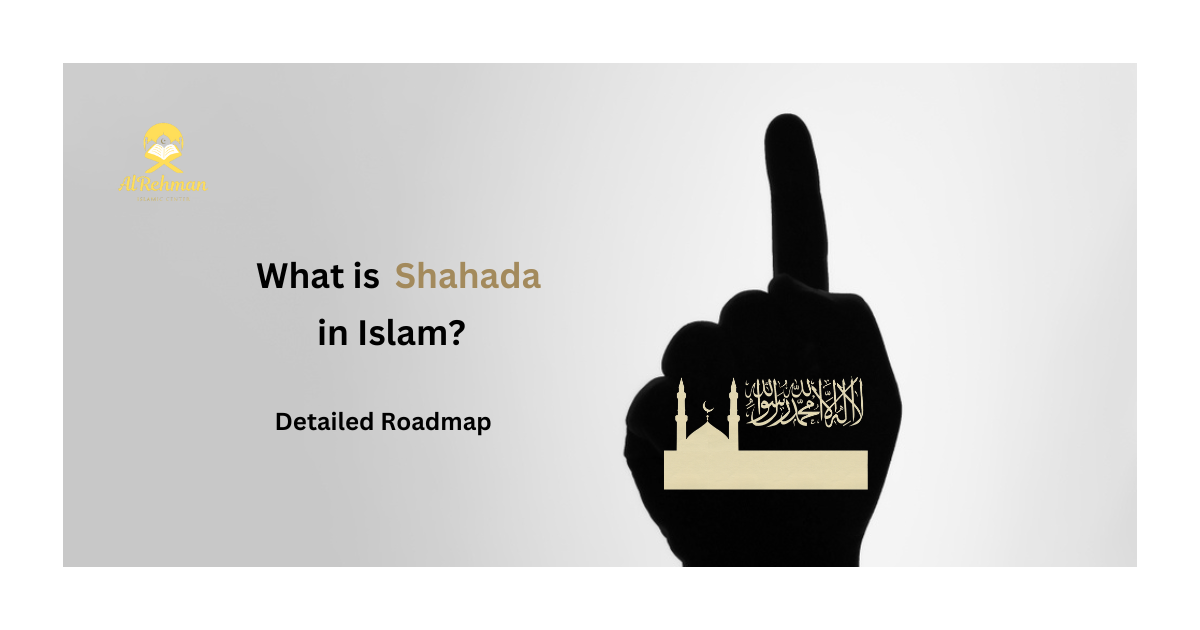
What is Shahada in Islam? Detailed roadmap
Table of Contents
Introduction
The Shahada is the core declaration of faith in Islam, affirming a Muslim’s unwavering belief in the oneness of Allah and the prophethood of Muhammad (peace be upon him). As the first pillar of Islam, it signifies the fundamental step for anyone accepting the faith. Additionally, it is recited by Muslims in their daily prayers and serves as a continual assurance of their commitment to Islam.
The Shahada consists of two key statements:
“Ash-hadu an la ilaha illa Allah, Wa ash-hadu anna Muhammadan Rasulu-Allah.”
This translates to:
“I bear witness that there is no deity but Allah, and I bear witness that Muhammad is the Messenger of Allah.”
This declaration forms the very foundation of Islamic belief, distinguishing Islam as a monotheistic religion that acknowledges divine guidance through Prophet Muhammad (peace be upon him).
Definition and Significance
The word Shahada originates from the Arabic root word “shahida,” meaning “to witness” or “to testify.” By reciting the Shahada, a Muslim affirms their witness to the truth of Allah’s oneness and Prophet Muhammad’s (peace be upon him) role as the final messenger.
Text of the Shahada:
Arabic:
َأَشْهَدُ أَنْ لَا إِلَهَ إِلَا اللهُ، وَأَشْهَدُ أَنَّ مُحَمَّدًا رَسُولُ اللهِ.
English Translation:
“I bear witness that there is no deity but Allah, and I bear witness that Muhammad is the Messenger of Allah.”
The declaration is a cornerstone of Islamic theology and serves as the entry point into Islam. By pronouncing the Shahada with sincere belief, one affirms their commitment to the oneness of Allah and the prophethood of Muhammad (peace be upon him).
This declaration is not merely a verbal commitment but a comprehensive oath to live according to Islamic principles.
Affirmation of Monotheism (Tawheed)
The first part of the Shahada, La ilaha illa Allah, proclaims that there is no god worthy of worship except Allah. This negates the worship of false gods, intermediaries, or partners with Allah. Belief in Tawheed (the oneness of Allah) is the fundamental principle of Islamic theology.
Acknowledgment of Prophethood
The second part, Muhammadan Rasulu-Allah, testifies that Muhammad (peace be upon him) is the final messenger of Allah. It signifies belief in all previous prophets while recognizing that the final and complete guidance was revealed through Prophet Muhammad (peace be upon him).

Recommended: What Are The Five Pillars Of Islam?
Importance OF SHAHADA in Islam
The Shahada serves as the cornerstone of the Five Pillars of Islam, highlighting its important role in shaping a Muslim’s faith and daily life. Shahada represents the acceptance of the Islamic faith and is a requirement for all other acts of worship.
For those born into Muslim families, the Shahada in Islam is introduced at a very early age and becomes an essential part of their daily lives through prayer and remembrance. For those who wish to convert to Islam, a sincere and public declaration of the Shahada is required. The act formally combines them into the Muslim community.
The Shahada in Islam also plays a vital role in daily acts of affection, including the five daily prayers (Salah), where its essence is repeatedly confirmed. It acts as a spiritual anchor, reminding Muslims of their tireless belief in the oneness of Allah and the finality of Prophet Muhammad’s (peace be upon him) message.
Recommended: What is the purpose of life in Islam?
Spiritual Meaning
Above its exact meaning, the Shahada in Islam holds a deep spiritual significance for Muslims. It is not just a verbal declaration but a heartfelt testimony that transforms a believer’s perspective on life.
The first part of the Shahada, “There is no deity but Allah,” highlights the concept of Tawheed (the oneness of Allah). The first part signifies that Allah alone is worthy of worship, and all aspects of life should be guided by His divine will. The commitment encourages a deep sense of dependence, gratitude, and affection for Allah.
The second part, “Muhammad is the Messenger of Allah,” highlights the importance of following the teachings and example of Prophet Muhammad (peace be upon him). It signifies that his life and message provide a perfect model for righteous living.
Together, these statements serve as a constant reminder for Muslims to live a God-conscious life. The Shahada encourages believers to desire sincerity, humility, and compassion in their actions, ensuring that their lives match Islamic principles.
In essence, the Shahada in Islam is a transformative principle that shapes a Muslim’s identity, guiding their spiritual journey and promoting a deeper connection with Allah and His Messenger (peace be upon him).
Recommended: Deepen your faith and understanding of the Quran.
Conditions of Shahada
For the Shahada (the declaration of faith) to be accurate and meaningful, several conditions must be met:
1. Sincerity (Ikhlas)
The declaration must be made with a pure and simple preference for the sake of Allah. Shahada in Islam should not be recited just for show or social reasons. The heart and tongue must match in complete sincerity, acknowledging the truth of the message.
2. Knowledge (‘Ilm)
A person should fully capture the meaning and importance of the Shahada. It is not just about verbal recitation but also about understanding and assuming its profound message. Knowledge means understanding that Allah is the only deity worthy of worship and that Muhammad (peace be upon him) is His final messenger.
3. Certainty (Yaqin)
There should be no doubt in the belief represented by the Shahada. The individual must believe firmly in the oneness of Allah and the Prophethood of Muhammad (PBUH) without any delay or uncertainty. The certainty provides a solid foundation for a Muslim’s faith.
4. Acceptance (Qabul)
The person must fully accept the truth of the Shahada in Islam without any form of rejection or opposition. This acceptance is a wholehearted embrace of Islamic principles, acknowledging that there is no power greater than Allah and that following His commands is the ultimate purpose of life.
5. Submission (Inqiyad)
Readiness to submit to the teachings of Islam is important. True approval of the Shahada involves a responsibility to live according to the guidance provided in the Qur’an and the Sunnah (traditions of the Prophet Muhammad), matching one’s actions with Islamic teachings.
6. Truthfulness (Sidq)
The statement must be spoken truthfully from the heart, with no falsehood or deception. A person reciting the Shahada must be sincere, ensuring their words reflect their true faith and belief.
7. Love (Mahabbah)
The recitation of the Shahada in Islam should be attended by love for Allah and His Messenger (PBUH). This love goes beyond mere acknowledgment and transforms into a desire to live a life that pleases Allah, with the Prophet Muhammad (PBUH) being the ideal role model.
Recommended: Let’s make Islamic education enjoyable for children.
When and How It is Recited
The Shahada is recited in various contexts, marking key moments in the life of a Muslim:
1. Conversion to Islam
A person formally becomes a Muslim by sincerely reciting the Shahada. Conversion to Islam act represents the transition into a new life dedicated to worshiping Allah alone and following the teachings of Prophet Muhammad (PBUH). It is often recited in the presence of witnesses, ensuring the genuineness of the transformation.
2. Daily Prayers (Salah)
Muslims confirm their belief in the Shahada during their daily prayers (Salah). At the beginning of every unit (Rak’ah) in prayer, Muslims recite the Shahada in the Tashahhud, professing the oneness of Allah and the finality of Prophet Muhammad’s (PBUH) message. The daily confirmation strengthens their faith and connection to Allah.
3. Life Events
The Shahada is often recited during significant life events as a reminder of faith. This includes moments such as:
- At the time of death: At the time of death it is expected to recite the Shahada near a person who is passing away to remind them of their faith and help guide their soul to the afterlife.
- Newborn’s ear: The Shahada is often whispered into the ear of a newborn to establish their connection to the Islamic faith.
- At moments of difficulty: Some Muslims recite the Shahada during times of personal problems, using it as a means of confirming their trust in Allah and seeking His guidance.
Recommended: Improve your Quran recitation through Tajweed.
Historical Background
The Shahada in Islam has its roots in the early days of Islam, revealed to Prophet Muhammad (peace be upon him) as a religious command to establish the oneness of Allah and lay the foundation of Islamic belief. At a time when false gods and idol worship were widespread in pre-Islamic Arabia, the Shahada served as a clear declaration of the Oneness of God, calling people to worship Allah alone and reject all false gods. It was one of the first and most important teachings of Islam, marking the shift from a society of worshippers of false gods to a community reserved for the worship of the one true God.
As Prophet Muhammad (PBUH) began preaching in Makkah, the Shahada became the core of the message and the first declaration of faith for new Muslims. It was through the Shahada that the earliest converts adopted Islam, openly declaring their belief in Allah and Muhammad as His messenger. The declaration of faith continued to play a key role as the Prophet migrated to Madinah, where it helped solidify the unity of the Muslim community.
Over the centuries, the Shahada has remained unchanged and timeless. It is recited by Muslims worldwide as both a personal commitment of faith and a unifying force, connecting people of all backgrounds and cultures under the same belief in the oneness of Allah and the finality of the Prophethood of Muhammad (PBUH). The Shahada has been taken as a symbol of the Islamic identity, representing the foundation of the religion and its continued relevance to Muslims across generations.
Conclusion
Understanding the Shahada is important for understanding the meaning of Islam. It is not just a statement of belief but a way of life that guides a Muslim’s actions, thoughts, and spiritual journey. Through the Shahada, a Muslim connects deeply with Allah and follows the noble example of Prophet Muhammad (peace be upon him), encouraging a life of purpose, affection, and peace.
Frequently Asked Questions
1. Can someone recite the Shahada silently in their heart?
While the Shahada can be spoken or whispered aloud, the key is sincere belief. However, reciting it out loud is advised, especially during meaningful moments like conversion or prayers.
2. Does the Shahada change for different Muslims around the world?
No, the Shahada is the same for all Muslims worldwide. However, language or culture always demonstrates the oneness of Allah and the finality of Prophet Muhammad (PBUH).
3. Can the Shahada be recited by someone who is unsure about their faith?
For the Shahada to be good, it must be recited with seriousness and certainty. Doubt would invalidate the declaration, as true belief is necessary for the Shahada to have meaning.