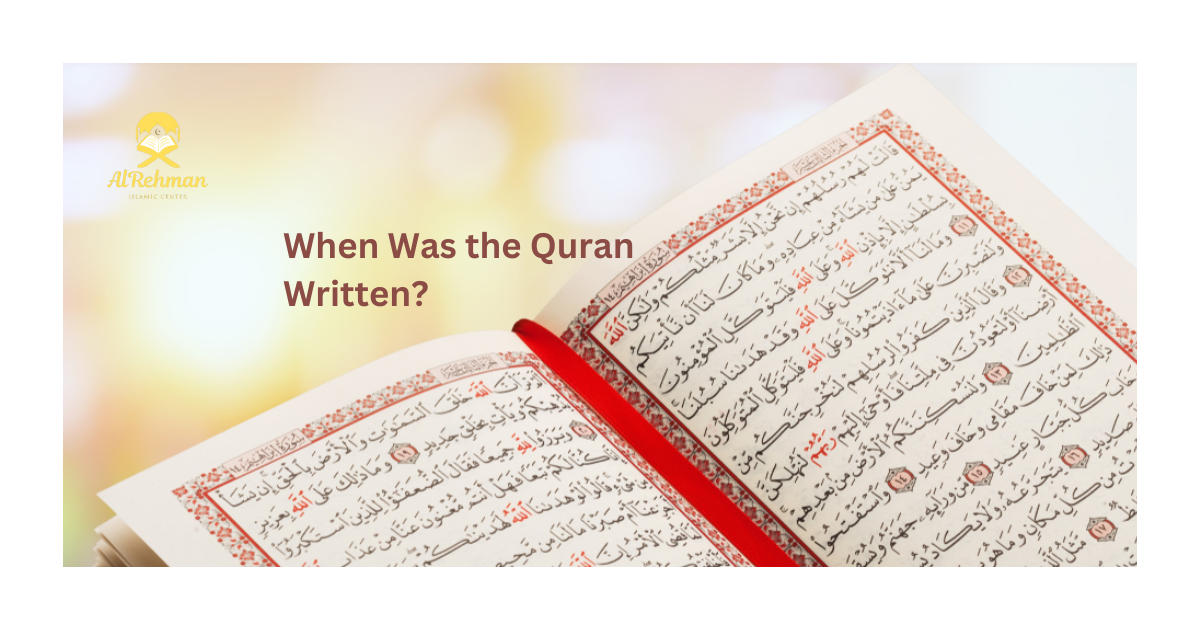
When Was the Quran Written?
Table of Contents
Introduction
The Quran, the sacred book of Islam, was revealed to Prophet Muhammad (ﷺ) over 23 years, starting in 609 CE and concluding in 632 CE. It is the ultimate guide for Muslims, covering every aspect of life, faith, and morality. During the Prophet’s lifetime, the Quran was mainly preserved through oral transmission, but it was also written down on materials like palm leaves, bones, and parchments by appointed scribes. The careful preservation and compilation of the Quran were essential in maintaining its authenticity. This article delves into when and how was the Quran written, compiled, and standardized, ensuring its unchanged preservation for over 1,400 years.
Recommended: Explore the principles of Islam and achieve proficiency in the Quran.
Revelation of the Quran
How and When the Quran Was Revealed
The Quran was revealed gradually over 23 years through Angel Jibreel (Gabriel) to Prophet Muhammad (ﷺ). It all began in the Cave of Hira during Ramadan in 609 CE, when the first verses of Surah Al-Alaq were revealed, highlighting the importance of knowledge and reading. Over the years, more revelations came, addressing different situations and guiding the Prophet and his followers in matters of faith, society, and law. The final verse was revealed in 632 CE, just before the Prophet’s passing, marking the completion of the divine message.
Oral Transmission During the Prophet’s Lifetime
In Arab culture, oral tradition was deeply rooted, so the Prophet’s companions memorized and recited the revelations with great devotion. Many of them committed the entire Quran to memory, and the Prophet himself would regularly recite the verses to ensure their accuracy. Every year, Angel Jibreel would review the Quran with the Prophet, and in the final year of his life, this review happened twice. Alongside this, the Prophet assigned trusted scribes to write down the revelations, preserving them in written form as well. This careful combination of memorization and documentation ensured the Quran remained authentic and unchanged.
Recommended: When Was The Quran Revealed?
Was the Quran Written During Prophet Muhammad’s (ﷺ) Lifetime?
Role of Scribes in Recording the Quran
The Quran was mainly preserved through oral transmission, but scribes like Zaid ibn Thabit (RA) also wrote down the revelations using whatever materials were available. They did this under the direct guidance of the Prophet (ﷺ) to ensure every word was accurate. The Prophet (ﷺ) would recite the newly revealed verses, the scribes would write them down, and then read them back to confirm they had recorded everything correctly.

Materials Used for Writing
The Quran was written down on palm leaves, bones, leather, and stones—whatever was available and durable at the time. While these writings weren’t compiled into a single book during the Prophet’s lifetime, they played a crucial role in preserving the revelations. The Prophet’s companions, who had memorized the Quran, used these written records as a reference. To keep them safe, these fragments were stored in different places, including the homes of the companions.
Recommended: Deepen your faith and understanding of the Quran.
Compilation of the Quran After Prophet Muhammad (ﷺ)
After Prophet Muhammad (ﷺ) passed away in 632 CE, the Quran was preserved in different forms—some parts were written on parchment, bones, and leaves, while much of it was memorized by his companions (Sahabah). As Islam spread and battles occurred, many of these companions, known as Huffaz (those who had memorized the Quran), were martyred. This raised concerns about safeguarding the Quran written in its original form. To ensure it remained unchanged for future generations, efforts were made to compile it into a single manuscript.
Role of Abu Bakr (RA) in Compilation
During Abu Bakr’s (RA) Caliphate, Umar ibn Khattab (RA) saw the urgent need to preserve the Quran in written form. He brought up the idea with Abu Bakr (RA), but at first, Abu Bakr (RA) hesitated since the Prophet (ﷺ) had never instructed such a compilation. However, after some reflection, he understood its importance and entrusted the task to Zaid ibn Thabit (RA), who had been the Prophet’s scribe.
Zaid ibn Thabit (RA) took on the careful and thorough job of gathering and verifying the Quranic verses. He collected written records from various companions and cross-checked them with the memorization of multiple Huffaz to ensure absolute accuracy. Eventually, he compiled the verses into a single manuscript, making sure that not a single word was changed or lost.
Preservation of the Manuscript
After the compilation was completed, the manuscript was entrusted to Hafsa bint Umar (RA), the wife of the Prophet (PBUH) and the daughter of Umar ibn Khattab (RA). She was known for her deep knowledge and reliability, making her the perfect guardian for this precious text.
During the Caliphate of Uthman ibn Affan (RA), differences in Quranic recitation started emerging in various regions. To prevent any confusion, Uthman (RA) ordered official copies to be made from Hafsa’s manuscript and sent across the Muslim world. This step ensured that the Quran remained consistent and preserved in its original form. The original manuscript stayed with Hafsa (RA) until she passed away.
Recommended: Improve your Quran recitation through Tajweed.
Standardization of the Quran Under Uthman (RA)
During the Caliphate of Uthman ibn Affan (RA) (644–656 CE), Islam spread far beyond Arabia, reaching Persia, the Levant, and North Africa. As more people embraced Islam, differences in Quranic recitation emerged due to varying Arabic dialects. Though these variations did not alter the meaning, they risked causing division among Muslims. To prevent this, Uthman (RA) took decisive action to standardize the Quran and preserve its uniform recitation.
The Need for a Unified Recitation
The issue of differing Quranic recitations was first brought to the attention of Uthman (RA) by Hudhayfah ibn al-Yaman (RA), a close companion of the Prophet (ﷺ). While on military campaigns, Hudhayfah noticed that soldiers from different regions were reciting the Quran in slightly different ways. This was because the Quran had originally been revealed in multiple Arabic dialects (Ahruf) to accommodate the various tribes of Arabia.
However, as Islam spread beyond the Arab world and more non-Arabs embraced the faith, Arabic became the common language of the growing Muslim empire. These dialectal differences, which once served as a convenience, began causing confusion and disagreements.
To protect the unity of the Muslim community and ensure the Quran remained unchanged, Uthman (RA) took action. He ordered an official standardized copy to be compiled, ensuring that all Muslims recited the Quran in the Quraishi dialect—the dialect spoken by the Prophet Muhammad (ﷺ).
Distribution of Standardized Copies
During the caliphate of Uthman (RA), he took a crucial step to ensure the Quran remained preserved in a single, standardized form. He appointed a committee, once again led by Zaid ibn Thabit (RA), who had previously compiled the first manuscript during Abu Bakr’s (RA) time. This committee relied on the manuscript safeguarded by Hafsa bint Umar (RA) as the primary reference and carefully transcribed multiple copies of the Quran.
Once these standardized copies were completed, they were sent to major Islamic centers such as Makkah, Madinah, Kufa, Basra, Damascus, and other key regions. Along with the copies, Uthman (RA) also sent skilled reciters to ensure people learned the correct pronunciation and recitation. To prevent discrepancies and maintain unity in the Quranic text, he ordered that any non-standard versions—whether personal notes or copies with dialectal variations—be destroyed.
This remarkable effort played a vital role in preserving the Quran exactly as it was revealed to Prophet Muhammad (ﷺ). The Uthmani Mushaf, the standardized script of the Quran, remains the foundation for all copies of the Quran written that exist today.
Recommended: What is the purpose of life in Islam?
How Was the Quran Preserved Over Time?
The Quran has been safeguarded for over 1,400 years through both oral memorization and written records, ensuring its authenticity. Unlike other religious texts that have been altered over time, the Quran written has remained unchanged since it was revealed to Prophet Muhammad (ﷺ). This preservation is a result of divine protection, as Allah Himself promises in the Quran:

Role of Memorization (Hifz)
One of the main ways the Quran has been preserved is through memorization, known as Hifz. During the Prophet’s (ﷺ) time, the Quran wasn’t just written down—it was also memorized by his companions. The Prophet (ﷺ) would recite newly revealed verses, and his companions would commit them to memory.
This oral tradition created an unbroken chain of reciters (Huffaz), ensuring the Quran’s authenticity. Even today, millions of Muslims, including children, continue this practice and become Hafiz (those who have memorized the Quran). This widespread memorization acts as a safeguard against any alterations, as even a single mistake in recitation is quickly corrected by others who know it by heart.
Recommended: Let’s make Islamic education enjoyable for children.
Early Manuscripts and Modern Preservation
From the very beginning, the Quran wasn’t just memorized—it was also written down. During Prophet Muhammad’s (ﷺ) time, his companions recorded the revelations on whatever materials were available, like palm leaves, parchment, bones, and leather. After the Prophet (ﷺ) passed away, the Quran was gathered into a single manuscript during Abu Bakr’s (RA) leadership and later standardized under Uthman (RA) to ensure consistency.
Historical manuscripts provide undeniable proof of the Quran’s preservation. One of the oldest surviving copies, the Birmingham Quran Manuscript, dates back to the Prophet’s time (between 568–645 CE), showing that the Quran has remained unchanged. Other ancient manuscripts, like the Sana’a Manuscript and the Topkapi Manuscript, further confirm its accuracy.
In modern times, the Quran is preserved through various means:
1. Printed copies
The Quran is mass-printed in millions of copies worldwide, ensuring accessibility for Muslims everywhere.
2. Digital copies
Quranic text is available in digital formats, including mobile apps, online platforms, and audio recordings.
3. Global recitation
The Quran is recited every day in prayers, mosques, and religious gatherings, keeping its pronunciation (Tajweed) and wording intact through generations. This careful preservation, both by memory and in writing, ensures that the Quran remains exactly as it was revealed to Prophet Muhammad (ﷺ), unchanged and authentic.
Recommended: What Are The Five Pillars Of Islam?
Authenticity and Unchanged Nature of the Quran
The Quran is the only religious scripture that has remained completely unchanged since its revelation over 1,400 years ago. While other religious texts have gone through revisions, translations, and modifications over time, the Quran has been preserved in its original Arabic, without any changes in wording, structure, or meaning. This fulfills the divine promise mentioned in the Quran:
“Indeed, We have sent down the Reminder (Quran), and indeed, We will preserve it.” (Surah Al-Hijr 15:9)
The Quran’s authenticity has been safeguarded through a dual preservation system—oral memorization (Hifz) and written documentation. This unique method has protected it from any alterations, ensuring that the Quran written remains exactly as it was revealed to Prophet Muhammad (ﷺ).
Conclusion
During Prophet Muhammad’s (ﷺ) lifetime, the Quran was recorded on various materials. After his passing, it was compiled into a single manuscript. Later, Caliph Uthman (RA) standardized the text to unify its recitation. To this day, the Quran remains unchanged, preserved as a testament to its divine protection.
Frequently Asked Questions
1. Has the Quran ever been changed or altered?
No, the Quran has remained unchanged since its revelation over 1,400 years ago. Both historical manuscripts and oral transmission confirm its authenticity.
2. How was the Quran preserved after the Prophet Muhammad (ﷺ)?
The Quran was preserved through memorization (Hifz) and written documentation. It was first compiled under Abu Bakr (RA) and later standardized by Uthman (RA) to ensure uniformity.
3. Are ancient Quranic manuscripts identical to today’s Quran?
Yes, scientific studies, including carbon dating, confirm that ancient manuscripts, such as the Birmingham Quran Manuscript, match the Quran we have today.
4. Why did Uthman (RA) order the destruction of non-standard Quranic copies?
To prevent dialectal variations from causing confusion, Uthman (RA) distributed standardized copies and ordered the removal of unofficial versions to maintain a single, accurate recitation.
5. How is the Quran preserved in modern times?
The Quran is preserved through printed copies, digital formats, and millions of Huffaz (memorizers) worldwide, ensuring its continued accuracy and authenticity.